
Why a swimming lab in Porto spent a morning on rowing ergometers

On 13 and 14 November the Faculty of Sport at the University of Porto held its Aquatic Biomechanics Days — two days of motion capture, drag measurement and an instrumented swimming pool. On the morning of the second day, one of the workshops was about a rowing machine.
The lab
LABIOMEP, the Porto Biomechanics Laboratory, is not a side project. It runs an instrumented swimming pool that lets researchers film and measure a swimmer above and below the waterline at the same time, and the two days in November were partly a ceremony for it.
European Aquatics president António José Silva came to Porto to unveil a plaque confirming LABIOMEP as an accredited European Aquatics sports science facility. A second plaque named it a Qualisys reference site, Qualisys being the motion capture system much of the lab’s work is built on. The opening ceremony was led by Fernando Gomes, president of the Portuguese Olympic Committee, alongside FADEUP vice-director José Afonso and LABIOMEP director João Paulo Vilas-Boas.
That is the context worth holding on to. This was a research laboratory being formally recognised by its sport’s European governing body, in front of its own national Olympic committee.
Rowing on a swimming programme
Aquatic biomechanics in Porto means swimming first, then kayaking, water polo and the rest. Rowing is usually somewhere near the back. This time it was not.
The first morning’s session on biomechanics and physiology ended with two rowing talks back to back: Joana Leão on intracycle velocity variations in on-water rowing, and Ricardo Cardoso on the parallels between flatwater and coastal rowing — a talk titled Bridging the Waters, which tells you roughly where the field’s attention is going.
That afternoon the Portuguese Olympic Committee, Vilas-Boas and Cardoso launched Track2Sea, a project funded by the Olympic committee and kicked off at the event itself. Coastal rowing joins the Olympic programme in Los Angeles in 2028, and national federations across Europe are now funding the science to catch up with it.
So rowing was not a guest slot. It had a research talk, a comparative talk, a project launch and, the next morning, a workshop of its own.
The only ergometer on the programme
The second day opened with land-based workshops. Workshop 2 was titled Biorower: next-generation ergometer for land training and assessment, and it was run by Ricardo Cardoso and Pedro Fraga.
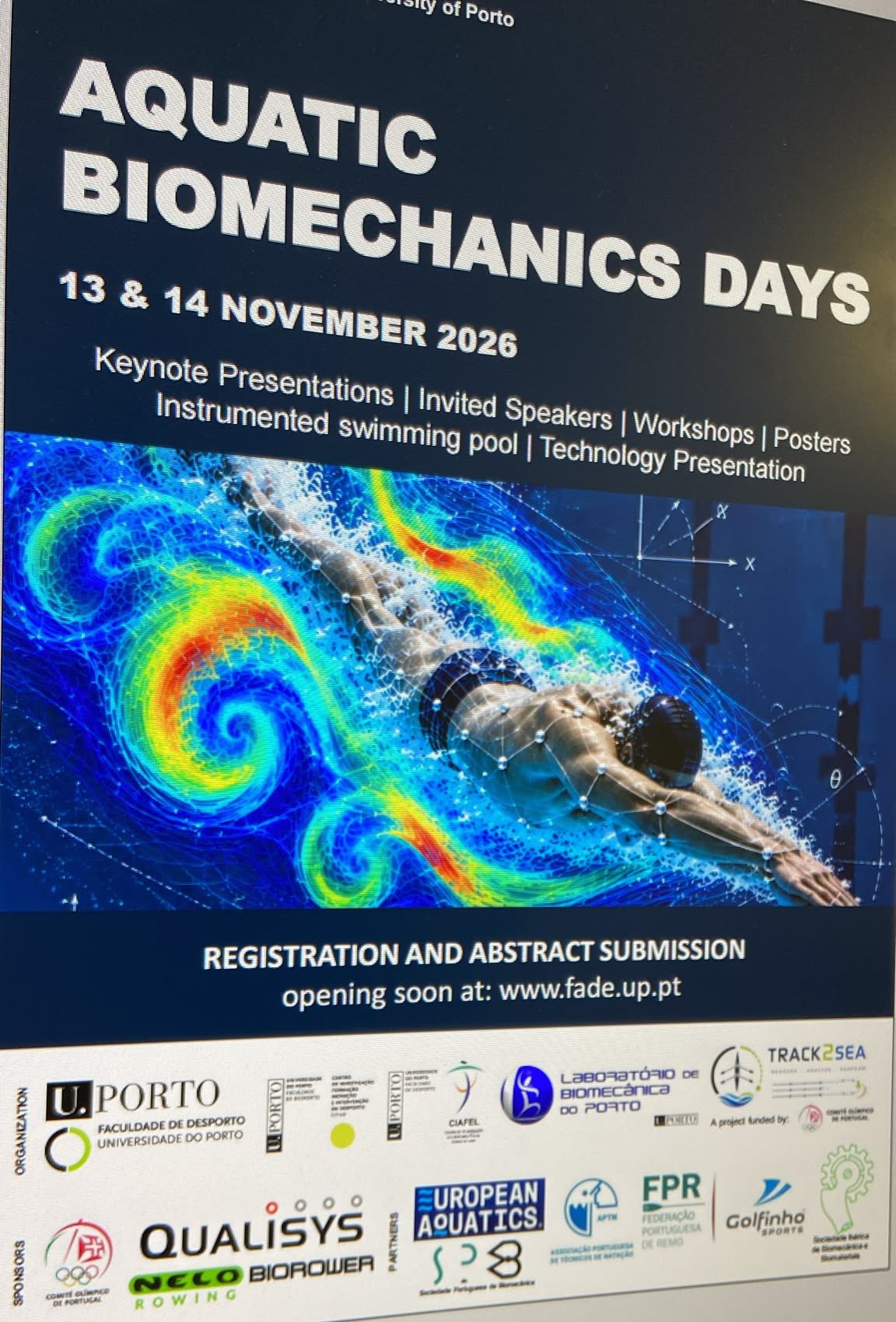
Across two full days — keynotes, poolside workshops, poster sessions, an entire session devoted to technology in sport — the Biorower is the only dry-land ergometer named in the programme. The lab has one for its research, and the event poster lists BIOROWER among the sponsors, next to Qualisys, Nelo Rowing and the Portuguese Olympic Committee. More on that in the disclosure below.
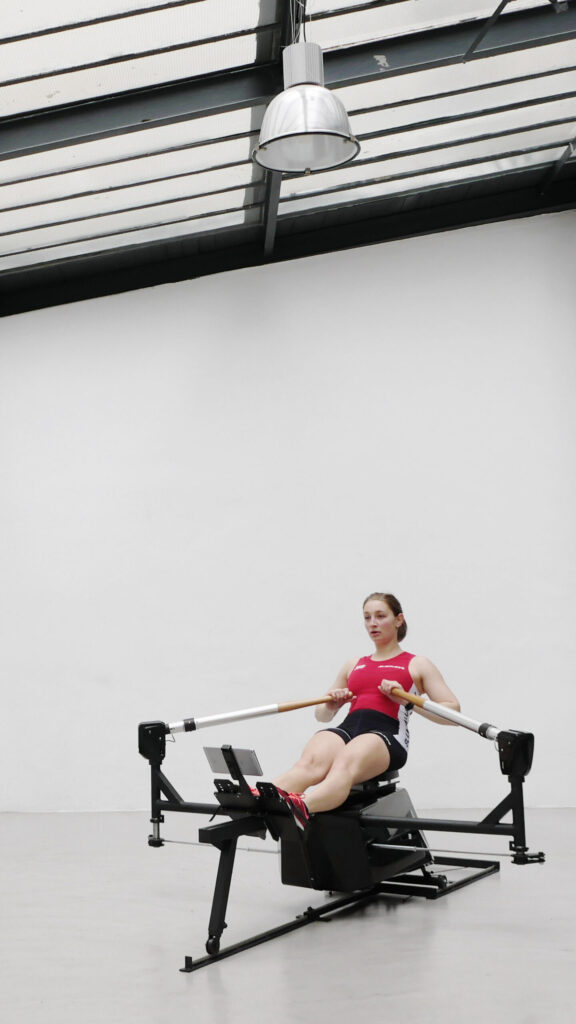
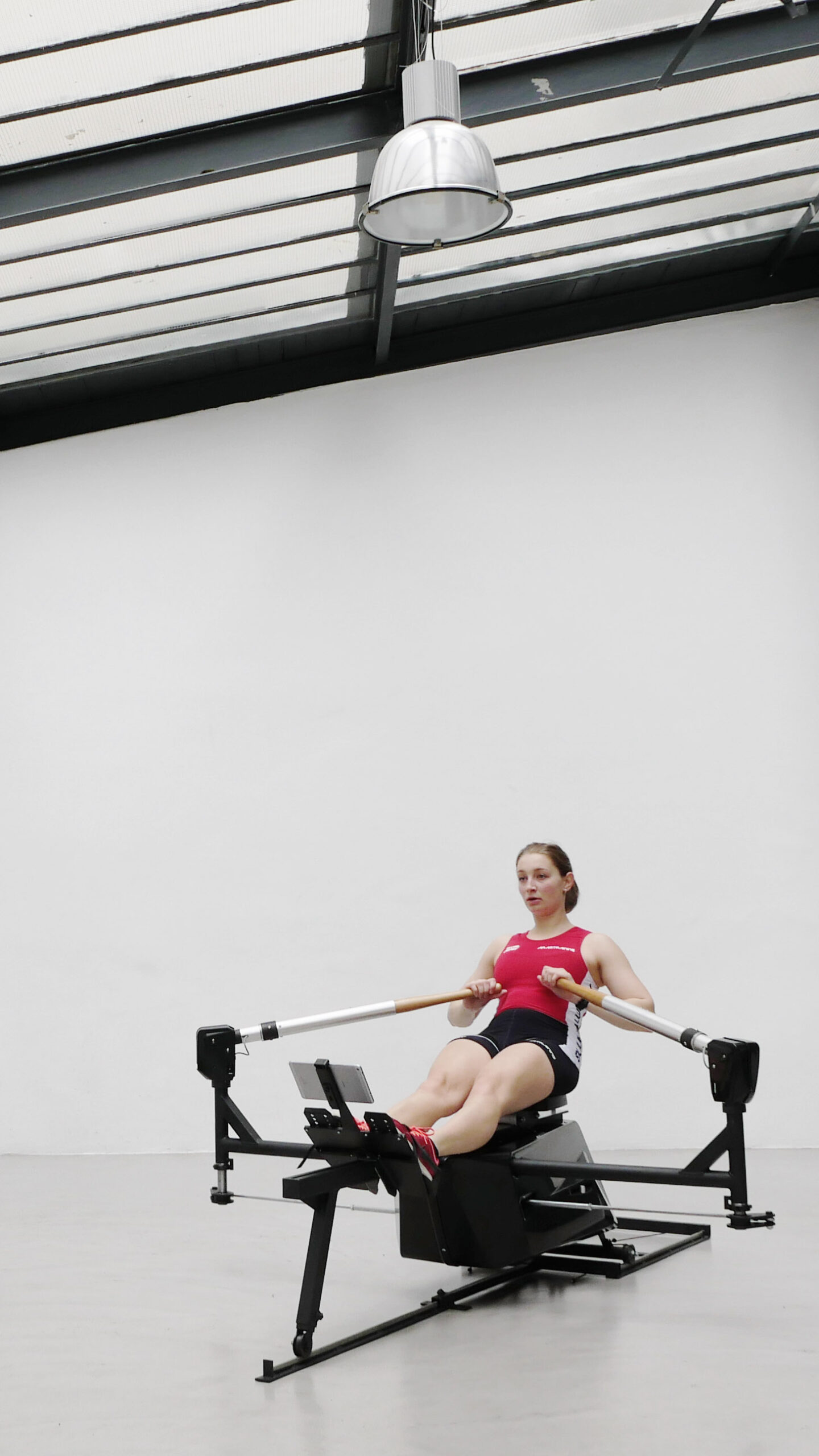
The Biorower is an Austrian machine that drives two oars on arcs rather than a single handle on a straight chain, so the hands travel the path they travel in a boat. Whether that difference matters enough to measure is precisely the question Porto has been working on.
What the research actually found
The workshop rests on a paper Cardoso and eight colleagues published in Sensors in August 2024. Sixteen trained rowers — eleven men, five women, all with at least three years of competition behind them — rowed an incremental test on a Biorower S1 Club and on a Concept2 Model D, forty-eight hours apart, in random order. The researchers measured gas exchange breath by breath, heart rate, blood lactate and perceived exertion, filmed the stroke with markerless motion capture, and tested core endurance with a plank before and after each session.
The findings, honestly summarised:
| What was measured | Result |
|---|---|
| Oxygen uptake, heart rate, lactate | Broadly similar on both machines |
| Stroke rate | Higher on the Biorower at heavy and severe intensity |
| Stroke kinematics | Clearly different — shorter propulsive length and a smaller thorax angle at the finish on the Biorower |
| Perceived exertion (Borg) | Lower on the Biorower: 14.38 against 15.88 |
| Core endurance 30 minutes after | Less impaired after the Biorower |
The authors’ own conclusion is one sentence: “The Biorower simulates on-water rowing, enhancing competition transfer and potentially reducing lower-back stress.”
The word doing the work there is potentially. The same paper reports that the biomechanical measurements agreed poorly between the two machines, which is a finding in both directions — the stroke really is different, and that also means numbers from one machine do not translate to the other. The authors list their own limits plainly: sixteen participants is a small sample, the two machines have different handles, and power profiles were not collected. Nobody in Porto is claiming the question is closed.
What they are claiming is that it is a question worth instrumenting — which, for a sport that has treated one ergometer as the definition of indoor rowing for forty years, is the interesting part.
What it means if you train indoors all winter
Most of us are about to spend four months on an ergometer. Two things from Porto are worth carrying into that.
The first is that your indoor split is a number about your ergometer, not about you in a boat. Porto measured the same rowers on two machines and found the physiology matched while the stroke did not. If the stroke shape differs, the thing you are grooving over ten thousand winter strokes differs too.
The second is more useful day to day. Perceived exertion came out lower on the oar-driven machine at matched work, and core endurance was less degraded half an hour afterwards. For a masters rower whose winter is limited by what the lower back tolerates rather than by what the lungs can do, that is the finding to watch — with the authors’ own caution attached, because sixteen rowers is sixteen rowers.
None of this makes one machine right and another wrong. It makes the choice of machine a training variable rather than a matter of what the gym happened to buy.
Disclosure
rowing.zone is run by Aram Lemmerer, who also founded BIOROWER, the Austrian company whose machine is the subject of the Porto workshop and the study above. The event poster lists BIOROWER among its sponsors. Lemmerer says the company paid nothing towards the event and that he did not attend: the laboratory has a Biorower for research, and his only instruction was to study whatever interested them, because he prefers true results. The 2024 study was funded by Portugal’s Fundação para a Ciência e a Tecnologia, and its authors declare no conflicts of interest. We are flagging all of this because a rowing site covering its own founder’s product should say so in the piece, not in the small print.
Sources
- Aquatic Biomechanics Days destacaram excelência científica e tecnológica da FADEUP, University of Porto news
- Aquatic Biomechanics Days — scientific programme (PDF), FADEUP, 22 October 2026
- EA President Silva to confirm University of Porto lab status, European Aquatics
- LABIOMEP organiza Aquatic Biomechanics Days na FADEUP, 28 October 2026
- Cardoso R, Rios M, Fonseca P, Leão J, Cardoso F, Abraldes JA, Gomes BB, Fernandes RJ, Vilas-Boas JP. Assessment of Angular and Straight Linear Rowing Ergometers at Different Intensities of Exercise. Sensors 2024;24(17):5686
- Aquatic Biomechanics Days event listing, University of Porto


Responses